Elliott
Wave Theory
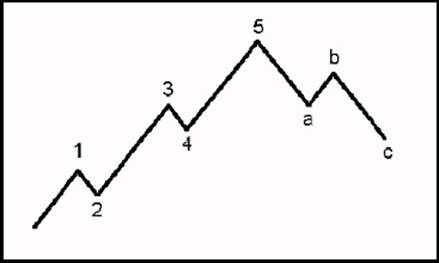
Elliott Wave Theory interprets market actions in terms of recurrent
price structures obedient to the Fibonacci sequence. Basically, Market cycles are composed of two major types
of Wave : Impulse Wave and Corrective Wave. For every impulse wave, it
can be sub-divided into 5 - wave structure (1-2-3-4-5), while for corrective
wave, it can be sub-divided into 3 - wave structures (a-b-c).
Surfer's
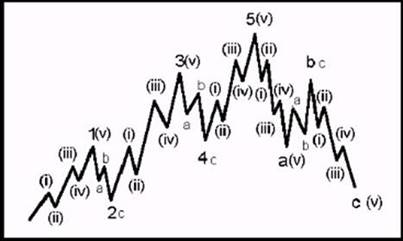
Waves within Wave
An important feature of Elliott Wave is that they are fractal in nature.
'Fractal' means market structure are built from similar patterns on a larger
or smaller scales. Therefore, we can count the wave on a long-term yearly
market chart as well as short-term hourly market chart.
See waves within wave:
Rules for Wave Count
Based on the market pattern, we can identify ' where we are' in term of
wave count. Nevertheless, as the market pattern is relatively simplistic,
there are several rules for valid counts:
-
Wave 2 should not break below the beginning of Wave 1;
-
Wave 3 should not be the shortest wave among Wave 1, 3 and 5;
-
Wave 4 should not overlap with Wave 1, except for wave 1, 5, a or c of
a higher degree.
-
Rule of Alternation : Wave 2 and 4 should unfold in two different wave
forms.
Wave forms in Impulse Wave
There are three major types of wave form in Impulse Wave:
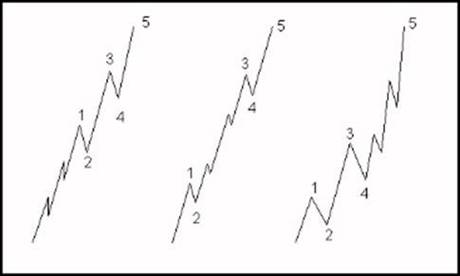
(a) Extended Wave
Among Wave 1, 3 and 5, only one should unfolded into extended wave. 'Extension'
means the wave is elongated in nature and sub-waves are conspicuous in
relation to waves of higher degree.
See extension pattern:
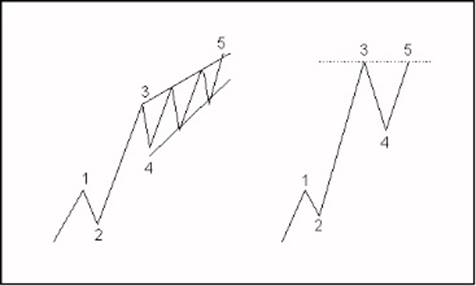
(b) Diagonal Triangle at Wave 5
Sometimes, the momentum at Wave 5 is so weak that the 2nd and 4th sub-waves
overlap with each other and evolved into diagonal triangle.
(c) 5th Wave Failure
In some other circumstances, the Wave 5 is so weak than it even cannot
surpass the top of the wave 3, causing a double top at the end of the trend.
See diagonal triangle and failure fifth pattern:
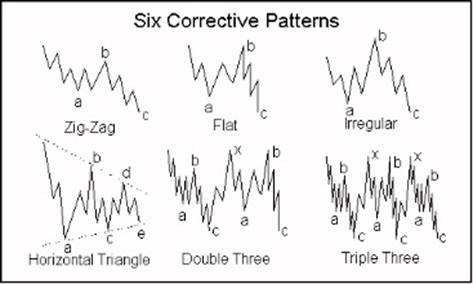
Wave Forms in Corrective Wave
Corrective Wave forms are rather complicated, but basically we can categorize
them into six major wave forms:
-
Zig-Zag : abc pattern composed of 5-3-5 sub-wave structure.
-
Flat : abc pattern composed of 3-3-5 sub-wave structure, with b
equals a.
-
Irregular : abc pattern composed of 3-3-5 sub-wave structure, with
b longer than a.
-
Horizontal Triangle : 5-wave triangular pattern composed of 3-3-3-3-3
sub-wave structure.
-
Double Three : abcxabc pattern composed of any two from above, linked
by x wave.
-
Triple Three : abcxabcxabc pattern composed of any three from above,
linked by two x waves.
See Six Corrective patterns:
Conclusion
The attractiveness of Elliott Wave Analysis is : Three impulse wave forms
and six corrective wave forms are conclusive. All we have to do is to identify
which wave form is going to unfold in order to predict future market actions.
This is a bold statement, needless to say, knowledge of market historical
wave patterns and experiences in wave count are of paramount importance.
Please read
disclaimer
 |
|
3 FREE Videos: Financial Market
Myths Exposed!
Elliott Wave International’s
Market Myths Exposed 3-part video series turns
conventional wisdom about the financial markets on its head, allowing you to
think independently of the mainstream and call your own shots regarding
portfolio management.
In these three videos – originally
presented to a full workshop at the 2007 San Francisco Money Show– Elliott
Wave International Chief Market Analyst Steven Hochberg, editor for EWI’s
Financial Forecast Service and close associate of distinguished
market forecaster Robert Prechter, debunks some of the most widely
held market myths and answers some of today's toughest questions
for traders and investors, including …
-
Why company earnings alone can't
drive share prices up or down.
-
Why Economics 101 does not apply to the financial
markets.
-
What's the deal with real estate?
-
Does a strong economy lead to strong financial
markets?
-
Is the Federal Reserve manipulating
market valuation?
-
Why do charts of the world’s markets look so
correlated?
-
And, most importantly, where should you put
your money?
-
Plus a whole lot more …
Many people pay hundreds
of dollars to attend the conferences at which Steve speaks. But now
you can get a front-row seat to Steve’s intimate workshop
setting without expensive plane tickets and hotel reservations. All
you need is a free Club EWI membership to watch!
Don't be fooled by market
myths from the mainstream financial media. Think independently – watch the
Market Myths Exposed video series FREE!
Sign Up to Begin the Video Series Now!
|
|
Gold, the Dow, T-Notes: Which Does Best During Recessions?
By Susan C. Walker,
Elliott Wave International
April 11, 2008
Each year, the NCAA college basketball tournament winnows its starting
field of 64 teams to the Final Four teams who play for a chance to become
the national champion. Congratulations to the University of Kansas and the
University of Tennessee, this year's men's and women's basketball
champions.
The structure of the NCAA tournament got me to thinking. Wouldn't it be
great if we could set up brackets for our own investments the same way –
start with 64 equities, bonds, mutual funds, commodity futures, metals,
etc. Then let them duke it out against one another to see which ones
emerge as the "Investment Final Four"?
Click here to download a free 5-page report from Elliott Wave
International with even more information on which investment does best
during recessions. The report, excerpted from Bob Prechter's Elliott Wave
Theorist, includes in-depth historical analysis and six eye-opening
tables.
Since most of us have neither the time nor the money to act as our own
version of the NCAA (which might stand for the "National Coordinator of
Asset Allocation"), it's worth knowing that Bob Prechter of Elliott Wave
International has already set his mind to the task. He has specifically
explored which investments do best in times of recession and which do best
during economic expansions. But instead of starting with a field of 64
investments, he researched the three most popular investments – gold, the
Dow, and Treasury bonds. We can call them the Treasured Three, rather than
the Final Four.
Gold and Recessions
Since economists and even Ben Bernanke, chairman of the Federal
Reserve, now admit that it looks like the U.S. economy has entered a
recession, many people may wonder whether they need to change the mix of
their investments. In particular, as some prices keep going up – notably
for food and gas – the threat of inflation makes people more interested in
gold as an investment, since it's usually seen as a bulwark against
monetary inflation.
It is this conventional wisdom that piqued Prechter's curiosity. He
wanted to find out whether it would hold up to a reality test. As he
writes in The Elliott Wave Theorist, "I have often read, 'Gold
always goes up in recessions and depressions.' Is it true? Should you own
gold because you think the economy is tanking? Whenever we hear some claim
like this, we always do the same thing: We look at the data."
So he and another Elliott wave analyst ran the numbers, reviewing the
behavior of these three key investments during recessions following World
War II, from February 1945 through November 2001. This is what they
learned:
Gold was not the best investment during recessions in terms
of total return.
The winner of this tournament was actually Treasury Notes, which had a
total return of 9.96%. In contrast, gold had a total return of 8.80%, and
the Dow came in at 6.89%. But that's not all – once they figured in the
transaction costs for each investment (at a 2008 level), gold fell from
second to third place as a worthwhile investment during recessions. The
total returns with transaction costs came out this way:
| 1. T-Notes |
9.82% |
| 2. Dow |
6.85% |
| 3. Gold |
4.80% |
This result turns conventional wisdom on its head. It's also worth
being aware of as you invest in 2008. Here's how Prechter sums up the
results:
The Best Investment During Recessions
The most important question, however, is not whether the Dow beat
gold or vice versa but whether making either investment would have been
better than taking no risk at all. Table 3 [see
free report provided by Elliott Wave International] shows that
ten-year Treasury notes beat both gold and the Dow during recessions
since 1945, and they did so far more reliably. T-notes provided
a capital gain in 10 of the 11 recessions, and of course they provided
interest income during all of them. And the transaction costs are low….
So if you want to make money reliably and safely during
recessions and depression, you should own bonds whose issuers will
remain fully reliable debtors throughout the contraction. Of course, as
Conquer the Crash [Editor's note: Bob Prechter's best-selling
business book] makes abundantly clear, finding such bonds in this
depression, which will be the deepest in 300 years, will not be easy.
Conquer the Crash forecast that in this depression most bonds
will go down and many will go to zero. This process has already begun.
This time around, you have to follow the suggestions in that book to
make your debt investment work. [The Elliott Wave Theorist,
March 2008]
Susan C. Walker writes for
Elliott Wave International, a market forecasting and technical
analysis company. She has been an associate editor with Inc. magazine, a
newspaper writer and editor, an investor relations executive and a
speechwriter for the Federal Reserve Bank of Atlanta. Her columns also
appear regularly on FoxNews.com.
|
Suddenly, It's a Bleak Midwinter for Housing and Lending
By Susan C. Walker,
Elliott Wave International
January 7, 2008
In the bleak midwinter,
Frosty wind made moan,
Earth stood hard as iron,
Water like a stone…
(From "A Christmas Carol" by Christina Rossetti)
Shawn Colvin sings a beautiful song based on this poem by Christina
Rossetti, reminding us of the bleakness of midwinter. That is exactly
where the housing market seems to be now – facing its very own bleak
midwinter of falling prices, rising mortgage rates and growing
inventories.
The latest report of the S&P/Case-Shiller home price index shows that
the price of houses fell 6.7% in October, year over year. That is the
largest year-to-year decline drop since April 1991. Think of it – if you
had bought a home for $300,000 in October 2006, it is now worth about
$280,000. And suppose you just got a new job and need to move? You are
going to have trouble selling it at that price, too, thanks to so many
foreclosed homes on the market. One realtor in Phoenix explained to a
Wall Street Journal reporter that local residents are now competing
with foreclosed homes selling for $50,000 to $100,000 less than other
houses on the market. "The sellers now are having to reduce their prices
by 20% to 30% to compete," she says. (Wall Street Journal, "Pace
of Decline in Home Prices Sets a Record," 12/27/07)
At a meeting of the New York Society of Security Analysts on January 7,
U.S. Treasury Secretary Hank Paulson said this about the U.S. economy: "We
will likely have further indications of slower growth in the weeks and
months ahead.''
Paulson and central bankers at the U.S. Federal Reserve recognize that
they, too, face their own bleak financial midwinter. It's not just the
mayhem brought on by the subprime mortgage debacle, the implosion of the
housing market and the ensuing credit crunch; nor is it that the U.S.
economy lurches toward a recession and hard times.
No, it is something bigger than that. Public opinion or social mood, as
we call it here at Elliott Wave International, has shifted from positive
to negative. When that happens, financial heroes find themselves falling
from their pedestals onto frozen earth hard as iron.
Exhibit A - The headline of a recent article on
Bloomberg: "Paulson Gets Diminishing Return with Bush, Like Powell,
O'Neill" and the lead: "Henry Paulson escaped the Nixon White House with
his reputation enhanced. He won't be so lucky this time around."
Exhibit B - The lead from a recent column by David
Ignatius in the Washington Post:
"When airport rescue crews are worried that a damaged plane may have
a crash landing, they sometimes spread the runway with foam to reduce
the probability of fire on impact. That's what the Federal Reserve and
other central banks are doing in pumping liquidity into severely damaged
financial markets. Make no mistake: The central bankers' announcement
Wednesday of a new coordinated effort to pump cash into the global
financial system is a sign of their nervousness…."
Nervousness is in the air now. Investors are anxious about the markets;
everyone is worried about the housing market. Our
Elliott Wave Financial Forecast December issue explains how housing
starts (and stops) are intimately tied to recessions: "One key indicator
of success in pre-dating economic downturns is housing starts, which are
approaching the 1-million-a-month level that has preceded all recessions
of the last 40 years."
And the Fed is nervous, too. So much so that it announced a credit
giveaway with four other major central banks (the Bank of Canada, the Bank
of England, the European Central Bank and the Swiss National Bank) in
mid-December to try to bolster the financial system and the banks that
keep it humming. The Fed reports that banks have been stepping up to its
auction window each week to purchase $20 billion. Unfortunately for the
banks, most of this "liquidity" isn't that liquid. It has to be paid back
within 30 days, with interest of about 4.65%.
Editor's note: Elliott Wave International
has agreed to make available to our readers a 2-1/2-page excerpt from Bob
Prechter's
Elliott Wave Theorist in which he describes exactly how the Fed's
latest effort to shore up banks' balance sheets has become "High Noon for
the Fed's Credibility."
Click here to read the Theorist excerpt.
Just how bleak is the future for central bankers if this recently
implemented plan doesn't work? Bob Prechter explains in his just-published
Theorist:
"Nevertheless, this is probably the single most important
central-bank pronouncement yet. But it is not significant for the
reasons people think. By far most people take such pronouncements at
face value, presume that what the authorities promise will happen and
reason from there. But the tremendous significance of this seismic
engagement of the monetary jawbone is that if this announcement fails to
restore confidence, central bankers' credibility will evaporate."
"At least that's the way historians will play it. But of course, the
true causality, as elucidated by socionomics, is that an evaporation of
confidence will make the central bankers' plans fail. The outcome is
predicated on psychology."
The "socionomics"
Prechter refers to is a new social science he has introduced that studies
how humans behave in groups within contexts of uncertainty – where
fluctuations in social mood motivate social actions. It explains that
rather than an event happening that affects social mood (for example,
falling home prices make people feel bad), what really happens is that
social mood changes first from positive to negative and then lousy things
happen (for example, unhappy people make home prices fall). If you can
adopt this point of view, then you can see that, in poetic terms, we are
fast approaching a bleak midwinter for the economy and the financial
markets.
Susan C. Walker writes for
Elliott Wave International, a market forecasting and technical
analysis company. She has been an associate editor with Inc. magazine, a
newspaper writer and editor, an investor relations executive and a
speechwriter for the Federal Reserve Bank of Atlanta. Her columns also
appear regularly on FoxNews.com.
|
Subprime Delivers One-Two Punch Just Like Hurricane Katrina Did
By Susan C. Walker,
Elliott Wave International
November 29, 2007
The world is awash in bad news about the subprime mortgage meltdown,
just the same way that New Orleans was awash in floodwaters from Hurricane
Katrina two summers ago. A few examples:
- The median price for new home drops 13% since last year, the most in
37 years, according to a Census Bureau report on November 29. This due
in large part to buyers not being able to get financing now that lenders
have tightened their lending standards in response to the subprime
debacle.
- Major Wall Street banks write off billions of dollars in subprime-backed
securities.
- Dire forecasts estimate that the credit crunch caused by the
mortgage problems will cause between $250 billion to $500 billion of
losses at banks and brokerages before it's done.
If you want to see how this kind of news looks on a price chart,
consider the chart that we published in the latest Elliott Wave
Financial Forecast. It shows how confidence in the mortgage market
has simply fallen off a cliff. "The ABX Mortgage Indexes are akin to the
eerie music that starts to play right before the goriest scenes in a
horror movie," write our analysts Steve Hochberg and Pete Kendall. Even
prime-rated mortgages (the top line on the chart) seem to have been
tainted by the cliff-diving exploits of the subprime and Alt-A mortgage
indexes.

Editor's note: Elliott Wave International invites you
to read more about this Mortgage Mutiny chart in a special three-page
excerpt from the November 2007 Elliott Wave Financial Forecast,
called
"Transition to a Fear of Risk."
The continuing repercussions of the subprime meltdown since two Bear
Stearns' hedge funds imploded in August remind me how closely this
situation imitates the delayed punch of Hurricane Katrina in the summer of
2005. In fact, I wrote a column for Fox News on that very topic a few
months ago, some of which is worth repeating.
* * * * *
[Excerpted from "Subprime Storm Mimics Katrina," originally published July
30, 2007]
Wall Street may have reason to worry about a financial hurricane poised
to do the same kind of damage Hurricane Katrina did — in terms of money
and assets lost — in New Orleans in 2005. Given the latest storm warnings
about subprime mortgages and the Dow’s dive last week, it looks like "Subprime
Katrina" might become the financial storm of the decade.
Wall Street investment bankers who remember the devastation in New
Orleans might want to start battening down the hatches. In fact, some of
them seem to understand their pending doom as they try to cajole the rest
of the world into thinking that the subprime (otherwise known as
low-quality) mortgage contagion is contained. 'Sure, sure, Bear Stearns
got hit when its subprime hedge funds lost their value, but everyone else
is O.K.,' they say. 'Let's all heave one collective sigh of relief that we
dodged that bullet.'
Does that attitude sound familiar? It's exactly how the people of New
Orleans felt for the 8-10 hours after Hurricane Katrina whipped up the
Gulf Coast and dumped its rain. It was over; they had dodged the bullet.
Their beautiful city that is built below sea level and surrounded by sea
walls and levees was safe. That's where Wall Street is right now – hoping
the levees will hold as investment bankers try to sandbag the rest of us
with lots of placating talk. Well, it turns out that New Orleans was about
as safe as the subprime bonds that are now below their own "C" level.
Although Wall Street bankers have been doing one heckuva job, I think
it's too soon to breathe easy, just as it was too soon for those in the
Big Easy to breathe easy. Here's why: Wall Street was warned about the
coming hurricane-force fall-out from subprime mortgages, and it ignored
the warnings, buying up all the securities backed by subprime mortgages
that it could. Now, Wall Street is having trouble selling more debt. It
sounds like it may be too late for many Wall Street denizens to get out of
town – and their positions – before the floodwaters start rising.
Remember, too, the finger-pointing and blaming that started as soon as
the rest of the nation realized that the U.S. government was not doing
enough to help New Orleans? The editors of The Elliott Wave Financial
Forecast recognize a similar change in attitudes toward Wall Street:
"The unwinding process will be sped along by a flood of revelations
about illicit hedge fund and investment banking activities. Just as
Enron, Tyco and a host of other primary beneficiaries of the late 1990s
bull market run became the focus of scandals, hedge funds and the banks
that enabled them are starting to become a focal point for scrutiny."
(The Elliott Wave Financial Forecast, July 2007)
Then will come the final installment. Just as the U.S. government was
slow to come to grips with the disaster in New Orleans so that people
were left to fend for themselves, so too will investment bankers and
investors have to fend for themselves. They may find themselves
clutching their worthless paper and wishing someone would bail them out
from the rooftops of their now-worthless homes.
* * * * *
Now, here we are at the end of November, and the situation for
investors and investment banks has played out almost exactly as I
outlined. Hardly anyone is coming out smelling like a rose. If anything
it's the opposite, as the stench from quarterly financial filings rises as
banks reveal how many billions in dollars they must write off for their
mortgage investments gone bad. Sadly, the conclusion to my Subprime
Katrina column still holds true: "Heckuva Job Brownie – now known as
Helicopter Ben Bernanke and his Federal Reserve team – won't have any more
luck picking up the pieces on Wall Street than FEMA did in New Orleans."
Susan C. Walker writes for
Elliott Wave International, a market forecasting and technical
analysis company. She has been an associate editor with Inc. magazine, a
newspaper writer and editor, an investor relations executive and a
speechwriter for the Federal Reserve Bank of Atlanta. Her columns also
appear regularly on FoxNews.com.
|
Why the Fed is Such a Lousy Wizard of Oz
By Susan C. Walker,
Elliott Wave International
September 7, 2007
Central bankers who "follow the yellow brick road" end up in Jackson
Hole, Wyoming, every Labor Day weekend for their annual symposium
sponsored by – who else? – the Kansas City Fed. (Who can forget Judy
Garland saying to her little dog, "Toto, I've got a feeling we're not in
Kansas anymore," in the 1939 movie, The Wizard of Oz?)
The Jackson Hole Resort serves as the Federal Reserve's equivalent of
the Emerald City, as Fed governors and presidents meet with central
bankers and economists from around the world to discuss economic issues.
This year, the symposium focused on housing and monetary policy. Usually,
the Fed chairman kicks off the symposium and, this year, the new chairman,
Ben S. Bernanke, did the honors. He closed his speech with these words:
"The interaction of housing, housing finance, and economic
activity has for years been of central importance for understanding the
behavior of the economy, and it will continue to be central to our
thinking as we try to anticipate economic and financial developments."
Then came the other speeches. And it seems that some of the guests in
Emerald City were waiting for their chance to pull back the curtain and
prove that the Wonderful Wizard of Oz isn't such a wizard after all.
Bloomberg reported that "Federal Reserve officials, wrestling with a
housing recession that jeopardizes U.S. growth, got an earful from critics
at a weekend retreat, arguing they should use regulation and interest
rates to prevent asset-price bubbles." Apparently, one academic paper
presented at Jackson Hole graded the Fed an 'F' for the way it has handled
the repercussions from the rise and fall of the housing market.
Truth be told, these folks are a little late to the table as critics of
the Fed. We're glad they're joining us, but here's what they still haven't
learned: It isn't because the Federal Reserve messes up by allowing
credit, asset and stock bubbles to form that it's not a wizard. The
Federal Reserve isn't a wizard for one particular reason that it doesn't
want anybody to know – and that is that the Fed doesn't lead the
financial markets, it follows them.
People everywhere want to believe in the
Fed's wizardry. But all this talk about how the Fed will be able to
help the U.S. economy and hold up the markets by cutting rates now is as
much hooey as the Wizard of Oz promising Dorothy, the Scarecrow, the Tin
Man and the Cowardly Lion that he could give them what they wanted: a
return to Kansas, a brain, a heart, and courage. Because when the Fed does
do something, it always comes after the markets have already made their
moves.
If you don't believe it, you should look at one chart from the most
recent Elliott Wave Financial Forecast. It compares the movements
in the Fed Funds rate with the movements of the 3-month U.S. Treasury Bill
Yield. What does it reveal? That the Fed has followed the T-Bill yield up
and down every step of the way since 2000. And the interesting question
becomes this: Since the T-bill yield has dropped nearly two points since
February, how soon will the Fed cut its rate to follow the market's lead
this time?
[Editor's note: You can see this chart and read the
Special Section it appears in by accessing the free report,
The Unwonderful Wizardry of the Fed.]
We've got our own brains, heart and courage here at Elliott Wave
International, and we've used them to explain over and over again that
putting faith in the Fed to turn around the markets and the economy is
blind faith indeed.
"This blind faith in the Fed's power to hold up the economy and
stocks epitomizes the following definition of magic offered by Teller of
the illusionist and comedy team of Penn and Teller: a 'theatrical
linking of a cause with an effect that has no basis in physical reality,
but that – in our hearts – ought to be.'" [September 2007, The Elliott
Wave Financial Forecast]
Because, you see, what makes the markets move has less to do with what
the unwizardly Fed does and more with changes in the mass psychology of
all the people investing in those markets.
The Elliott Wave Principle describes how bullish and bearish trends in
the financial markets reflect changes in social mood, from positive to
negative and back again. To extend the metaphor: The Fed can't affect
social mood anymore than the Wonderful Wizard of Oz could change the
direction of the wind that brought his hot air balloon to the Land of Oz
in the first place.
As our EWI analysts write, "With respect to the timing of the
Federal Reserve Board rate cuts, we need to reiterate one key point. The
market, not the Fed, sets rates." Being able to understand this
information puts you one step closer to clicking your ruby red shoes
together and whispering those magic words: "There's no place like home."
Once you land back in Kansas, your eyes will open, and you will see that
an unwarranted faith in the Fed was just a bad dream.
Susan C. Walker writes for
Elliott Wave International, a market forecasting and technical
analysis company. She has been an associate editor with Inc. magazine, a
newspaper writer and editor, an investor relations executive and a
speechwriter for the Federal Reserve Bank of Atlanta. Her columns also
appear regularly on FoxNews.com.
|
 |
|